
3S · ENERGY SERVICES
Energy audits
Understand your facility’s energy consumption to identify, quantify and prioritise improvements on technical and financial grounds.

3S Energy Audits
01 / SCOPE
A complete picture of energy performance.
An audit examines the energy consumption profile of a facility, building or process. It relates supplies and equipment to actual operations and identifies improvement opportunities, their financial impact and investment priorities.
Demand, networks and equipment
Capacity, load profiles, energy users, transformers, motors, pumps, lighting and power quality.
Heat, steam and combustion
Boilers, distribution, insulation, cogeneration, furnaces, heat treatment and efficiency.
Cooling, compressed air and vacuum
Industrial refrigeration, compressors, high- and low-pressure systems, losses and operating conditions.
Processes and operating cycles
Production lines, presses, injection moulding, extrusion, operating loads, downtime and activity-related ratios.
HVAC and control
HVAC, lighting, BMS and building consumption, including fleet consumption where relevant.
Thermography and submetering
Verification through measurements, thermal imaging, sensors and energy performance indicators (EnPIs).
02 / TECHNICAL UNDERSTANDING
From scattered consumption data to an energy map.
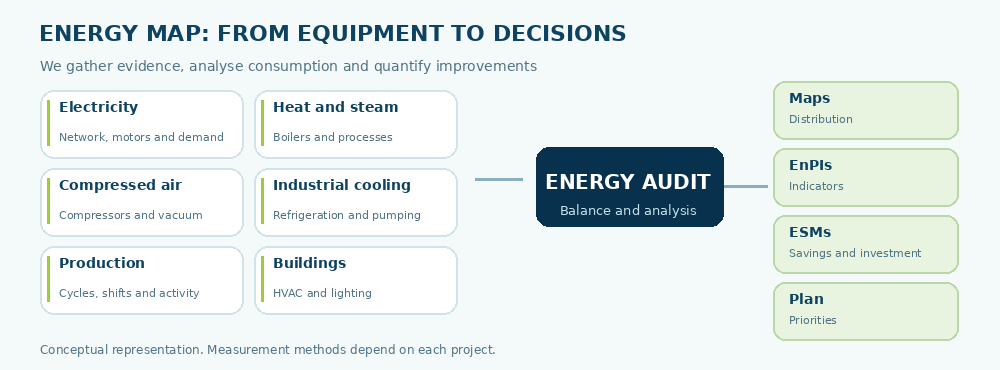
Supply, facility and process data are organised into balances, consumption maps, indicators and quantifiable energy-saving measures. The diagram illustrates the analysis method, not a specific installation.
03 / METHODOLOGY
A thorough audit with a clear roadmap.
The method combines a review of documentation, any necessary site visits and measurements, and technical analysis of each system before improvement proposals are presented.

04 / FINDINGS
Recommendations that support investment decisions.
Audit report
A technical document setting out consumption profiles, identified opportunities, reference indicators and an assessment of the proposed measures.
EN 16247 · where applicable- Energy maps and balances by consumption centre.
- Energy performance indicators (EnPIs).
- Energy-saving measures, with and without investment.
- Technical and financial feasibility of each measure.
- Investment, savings and simple or lifecycle payback, according to scope.
- Priorities, schedule and implementation proposal.
Technical and regulatory framework. 3S performs audits in accordance with the EN 16247 series where required by the engagement, taking account of applicable legal obligations, including those affecting large companies. Specific requirements are confirmed for each customer and facility.
05 / DOCUMENTATION FOR REQUESTING A PROPOSAL
Sector-specific quotation request templates.
The seven original PDF documents from the 3S website are retained with their existing file names and download links. Choose the template that best describes your facility.
The downloadable documents are the original property of 3S.